
Collinsville City Directory Holdings
The clearest verified shelf list comes from the St. Louis County Library’s Illinois directory inventory. It identifies Collinsville volumes for 1979 through 1982 and selected years from 1991 through 2001. The older group is marked “print ask at desk,” while later volumes carry call number R 917.7386 C713. The same library lists nearby phone books from 1972, 1977, and 1978. These are catalog facts, not a claim that every year or every street section is present today, so contact the reference desk before making a trip.
| Collection | Years | Where Held | Access |
|---|---|---|---|
| Collinsville directories | 1979, 1980, 1981, 1982 | St. Louis County Library | Print, ask at desk |
| Collinsville directories | 1991, 1993, 1995–1997, 1999–2001 | St. Louis County Library | Reference shelf, R 917.7386 C713 |
| Regional phone books | 1972, 1977, 1978 | St. Louis County Library | Confirm with reference staff |
| Polk directory holdings note | 1966–1992, with gaps | Belleville Public Library in a 1999 report | Historical inventory, current access unconfirmed |
No verified continuous run or current reverse directory was found. A 1999 geological survey report said Belleville Public Library then held Collinsville Polk directories from 1966 through 1992, with missing volumes. Treat that as a lead to check, not a current access promise. Gaps matter because a missing name may reflect the shelf, not a move. Ask staff for the exact year, publisher, page format, and whether the book contains both alphabetical and street-order pages.
Collinsville Library Research Desk
The Mississippi Valley Library District’s Collinsville branch at 408 W Main is the local starting point when the city directory shelf is incomplete. Call 618-344-1112 and ask about street sections, missing volumes, local newspaper access, obituary indexes, vertical files, and scans or microfilm. Its genealogy resources also lead to HeritageQuest, FamilySearch, the Collinsville Churches Index, and historic landmark material.
The University of Illinois Newspaper Project identifies the Advertiser, Collinsville Argus, and Collinsville Herald among the branch’s holdings. Some catalog dates contain the letter “u,” such as 1911–19uu. That marks an incomplete date, not a real end year. Email the genealogy contact at lesleeh@mvld.org to confirm the original run and the available format before citing an issue.
Note: Preserve the title, issue date, page, and image or reel number for each Collinsville newspaper match.
Collinsville Directory Years Online
The directory inventory itself is available on the library’s website, and the successful capture below shows the Collinsville entries in that official holdings list. Open the Illinois city-directory list before using the image so changes to access notes or call numbers can be checked at the source.
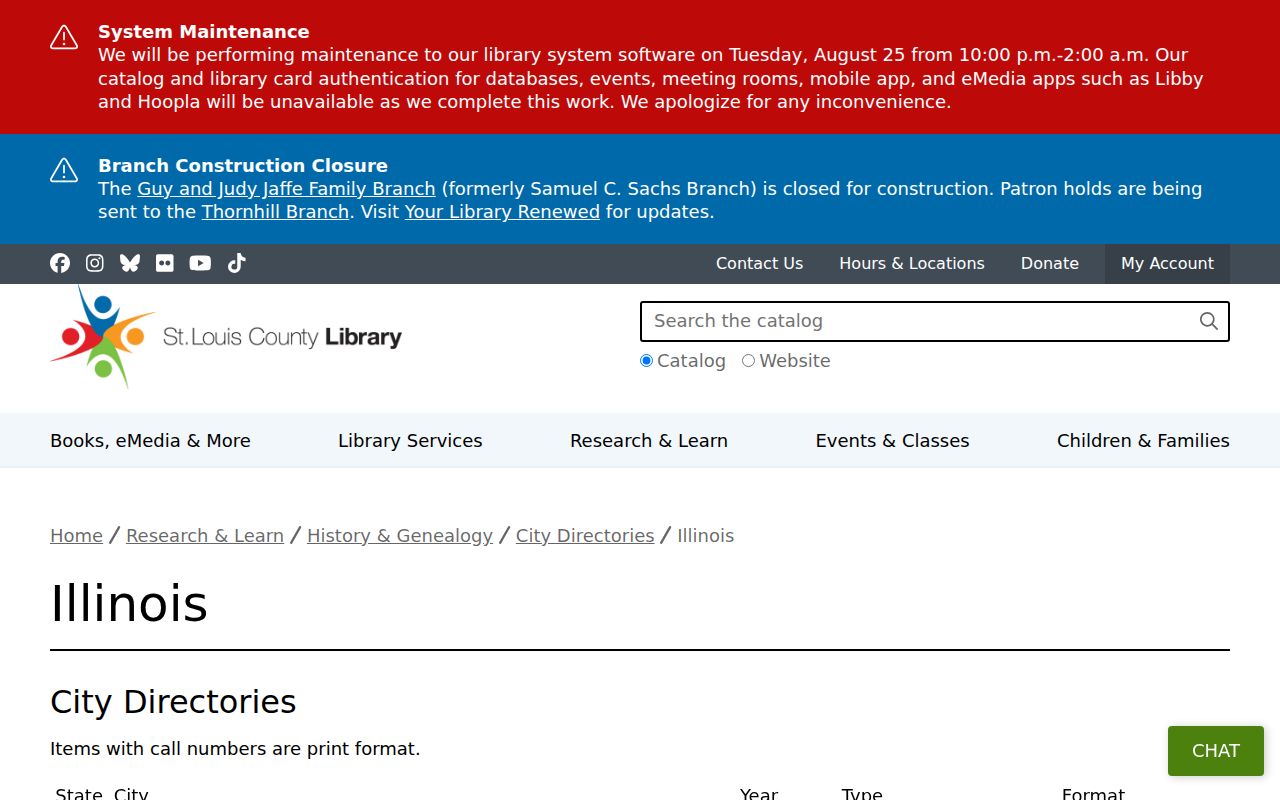
The capture makes the scattered year pattern easy to see. It also shows why a city directory search should log missing years instead of silently treating them as proof that a person left Collinsville.
Reading Collinsville Directory Entries
Read the volume’s own key before expanding any short form. A Collinsville city directory entry may give a name, address, work or civic description, and sometimes a spouse or household marker, but the exact fields vary by publisher and year. The verified D.D. Collins House history provides a local model: it places Sophie Schmitz at 621 W Main in a 1911–12 directory and William E. Bonn there in 1916. That nonprofit history also points to deed dates, yet the original page and recorded instrument remain the stronger evidence.
| Name | Copy spelling, initials, and any linked household name exactly. |
|---|---|
| Description | Record the printed trade, employer, civic role, or other label without adding an inference. |
| Address | Keep the house number, street spelling, and any residence or boarding abbreviation. |
| Entry type | Mark whether it is a name listing, advertisement, street cross-reference, or phone-book line. |
| Citation | Save the title, publisher, year, page, and repository. |
- Criss-cross directory
- A directory arranged by street and house number instead of only by surname.
- Householder index
- A list keyed to the named person responsible for a household entry.
- Abbreviation key
- The publisher’s legend for short forms. Copy it because meanings can change by volume.
Collinsville City Directory Gaps
The inspected catalogs confirm alphabetical directories and phone books, but they do not confirm that each Collinsville volume includes a reverse, street-order section. Ask the holding library directly. If it does, search the street spelling and house number, then note nearby entries only when they help identify the same block. If it does not, start with a surname or turn to a dated newspaper, map, deed, or census record.
A person missing from one city directory may have been omitted, unlisted, away when data was gathered, or filed under another spelling. The book is a dated publication, not a live resident roll. Search one volume before and after the target year. Keep negative results in the log because they show what was checked, but do not treat them as proof of absence.
Map Collinsville Directory Addresses
Two free Sanborn map records add a strong address layer. The Library of Congress 1898 Collinsville map has four sheets. The University of Illinois 1915 item has 16 color sheets at about 1:600 scale. Start with each key sheet, then log the sheet, block, street, house number, and map label.
Sanborn sheets show site use, building shape, property lines, construction, openings, and water features. They help explain why an old Collinsville address appears in a business, civic, or property record. They do not name all occupants. Pair a map label with a dated city directory or newspaper entry and, when ownership matters, a county deed or plat.
| Year | Source | Sheets | Best Use |
|---|---|---|---|
| 1898 | Library of Congress | 4 | Earlier block and building context |
| 1915 | University of Illinois | 16 | Later block, property, and use comparison |
Collinsville Names Beyond Directories
The Madison County Circuit Clerk digital archive can extend a Collinsville name trail well before the verified directory shelf. Its naturalization collection covers 1850 through 1959 in 122 volumes and can be searched by names, aliases, spouse or child, year, and type. Probate books cover 1800 through 1976 in 458 volumes. The 1820 through 1860 emancipation register has three volumes and a transcript and must be handled as a historical archival record, not as a modern identity source.
The Illinois State Archives probate index contains 7,174 Madison County records from 1813 through 1903. An index result supplies an estate name and box or tray location. For a copy, contact IRAD at SIU Morris Library by mail or phone at 618-453-3040; the research notes say not to request copies by email. Provide the estate name, county, accession, and box or tray data.
Collinsville Archives and Churches
The Madison County Historical Society archive at 801 N Main in Edwardsville holds maps, photographs, books, scrapbooks, Bibles, manuscripts, diaries, and newspaper clippings from before 1812 to the present. Search its PastPerfect catalog by a Collinsville family, street, group, building, or event. Catalog text is a finding aid. Ask for the underlying item or a reproduction before relying on a detail.
The Collinsville Historical Museum at 406/407 W Main is described in the city’s preservation standards as holding local documents and artifacts from 1767 onward. The library’s Collinsville Churches Index and Glenwood Cemetery material can bridge a city directory name to a church, death notice, or burial lead. Confirm hours and reproduction rules before visiting, and avoid turning cemetery placement into a complete life story.
Trace Collinsville Family Directory Years
A year-by-year log keeps a city directory match tied to its source. Start with the closest known date. Follow the same spelling, initials, address, and printed description across nearby volumes, then use a census year as a separate household snapshot. Collinsville’s county setting matters: Madison County was created in 1812, while part of the modern city lies in St. Clair County. Choose archives based on the dated place, not just the word Collinsville.
- Locate the nearest listed Collinsville volume and copy the full entry, page, year, and repository.
- Check the volumes on both sides of that year. Record spelling shifts, moves, and gaps without guessing their cause.
- If the book has a street section, confirm the house number there. Otherwise use a map or newspaper.
- Compare the directory year with the nearest census, deed, probate, church, or newspaper record.
- Close the log with a dated source such as an obituary, cemetery file, later directory, or recorded instrument.
A final line should separate fact from inference: “listed at” is safer than “lived at” unless the original record states residence. For a modern check after a historical find, the Collinsville resident lookup explains how to compare current official indexes without treating an old listing as a present address.
Historical use. A Collinsville city directory entry is dated evidence, not proof of a current home or a complete household.